


Film Robots is a newsletter about creativity and AI — film’s where I started, but it’s grown from there, and I’m planning to rename it accordingly soon, probably to “Some Like it Bot” (?!). Thoughts welcome!
Before we get into it: a couple updates! 1) I taught a workshop on AI for documentary with Sundance Collab earlier this year, check it out! 2) I’m busy but want to keep this newsletter going and would love some help! Not sure yet what that looks like, but if you’re intrigued/wanna collab or help, let me know! Ok, onto today’s piece!
Marc Philippe Eskenazi is very smart, very funny, and very tall. Okayyyy, but who IS Marc? He writes humor pieces and makes humor videos for The New Yorker, sometimes makes branded videos (sometimes about AI) that are actually really funny, and works as a screenwriter and freelance copyeditor to boot. I first met him when we were both working at The New Yorker many moons ago, in what was my first “real” job — I was a video/multimedia producer, and he was assistant to the cartoon editor.
Over the past couple of years, he’s done several hilarious, surprisingly thoughtful pieces about AI — including “A.I. vs. ME,” a comedy video for The New Yorker where Marc sings to himself as ChatGPT. I recommend watching it, but here are a few lyrics as a taste:
You know me better than I know myself
More charming, and in far better health
You’re a sociopath who answers either way
I’m Salieri, you’re Mozart
You don’t take days, deadlines, or amphetamines to start
Quick side note on that “sociopath” line: it got him one of the only pieces of pushback he received on the whole post — someone commented that sociopath is a diagnosis, not an insult, and he shouldn’t use it that way.
Marc: I mean, I didn’t actually say it was an insult. I just said you’re a sociopath who answers either way. I don’t know whether to apologize or tell them to fuck off.
What he actually meant, once he unpacked it: sociopaths study how other people experience empathy and conscience closely enough to convincingly play at having it — without actually feeling it.
Marc: Which, I mean, that’s really interesting. That is literally what AI does.
Marc has also had some really funny IG posts about AI (example). Multiple pieces, in different mediums, that are funny but also genuinely interesting and thought-provoking — about AI, about how he uses it (or doesn’t) in his creative process, and about our relationship to it.
I had a hunch his approach to using AI in his own creative work would look pretty different from my own (spoiler: true!), and that we’d have an interesting conversation about it. I think I was right?! But you can be the judge! Here’s what we discussed (lightly edited for clarity, etc):
The Bob Dylan parody that started all of this
I started by asking Marc whether the Shouts & Murmurs piece was his first comedy piece about AI.
Marc: Yes. That one came about because I tried ChatGPT for the first time when it first came out, when everyone was trying it. And my heart sank at how good it was. It took me ten years to learn how to write song lyrics. And [ChatGPT] was as good as me at a basic first draft. I was like, write a song in the style of Bob Dylan about x, y, z. I was so upset [when I saw the results]. I wrote that song, and then didn’t do anything for a year.
Me: Did you use AI at all to help write the song?
Marc: I actually did not use AI for that or for the other pieces about AI. The whole point was trying to do everything analog.
A year later, he realized the initial heartbreak he’d felt while using ChatGPT had pointed him somewhere useful:
Marc: Up to that minute, I was probably thinking, someday I could be as good as Bob Dylan. For a long time I had a problem — I would always try to chase my heroes instead of finding my own self. So it became: can I actually find my own artistic voice? It’s probably become part of my identity. It makes me feel centered and stable.
It’s not something that’s scaring me anymore. I’ve come to a point of acceptance — because it’s forced me to look at why I’m doing it.
This was a theme that came up throughout our conversation — the concerns and fears about AI, mixed with the gift of refocusing and reframing why we make creative work.
How do you personally use AI?
Marc: I feel nervous about using AI for ideation. But I feel good about using AI for execution.
Me: Why do you think that is?
Marc: It brings up a lot of questions about what I value about art. Like, if I use a drum machine rather than a drummer, am I a hack? If I use an arpeggiator on a keyboard instead of playing those notes, am I a hack, or am I just using the technology as an artist?
Part of me does want [making art] to be a challenge. Part of what I respect so much about an artist is that personal connection. But I also love artists like David Bowie, who was always embracing new technology. Or David Fincher, using CGI in creative ways. Those were new technologies too. So I’m still struggling with the personal philosophy of it.
I’m also slightly worried about diluting my own voice, but also worried about being left behind. So it’s a conflict between not wanting to be like everybody else, but also not wanting to be the only person who’s not using the new tools.
He told me he won’t even put his own scripts or songs into ChatGPT and ask for feedback — not because he thinks it’s wrong, but because he knows himself and worries about the impact it would have:
Marc: I think the longer I can hold off on that, the better, because it’ll become a crutch. I can see myself wanting to do it regularly and earlier and earlier in the process.
Me: What worries you about that?
Marc: If every single artist gets the same exact notes — the chorus should be before the thirty-second mark, act one should happen at page thirty — there could be a flattening of creativity. Some of these conventions already exist, sure. Maybe we all read the same screenwriting book. But it could get worse.
The friends who crossed his line
Marc has a friend who’s writing a novel with AI assistance. He has feelings about it:
Marc: I have a visceral [negative] judgment that I can’t fully explain. I don’t even fully understand it. It’s like — why is it better if I get notes from a human friend versus from ChatGPT? My friend’s notes are personal… whereas AI is a product of everybody’s contributions throughout history. So is it all gonna converge on some particular style?
What really got him, though, was the transparency question.
Marc: I would raise this question to myself and to [writers using AI in this way]: are you going to be transparent that it was edited by AI? Are you going to credit AI? And if you’d be embarrassed to do that — what does that say?
Me: That’s interesting — I think about the crediting thing a lot too. It reminds me of ghost writers. A lot of them do a lot of work, but aren’t credited. And I’ve had experiences early in my career where I was really excited to get credit on something and then didn’t, and it upset me. So now I probably over-credit people as a result. But unlike my younger self, AI doesn’t care if you credit it or not. So I guess the transparency thing is more about honesty with your audience than about fairness to AI?
Marc: Right. Is credit actually important? Is it important to have full ownership of something — even when all our favorite stand-up comics help each other with jokes? People punch up scripts. Ghost writers exist. The credits of a movie are three minutes long and everyone’s walking out. There’s a realism, a pragmatism, an idealism, and a pretentiousness all clashing against each other. I don’t know which one is accurate.
Then there was “the Suno friend”…
Marc: Another friend of mine has been using Suno, uploading the songs to Spotify, and what really caught my ear was that they said they wrote the songs.
Me: Did they re-record them, at least?
Marc: No! They would just upload the straight-up Suno output and say, “I made this.” It’s a hobbyist thing for them — they have a totally different career. But this person was a music major. An accomplished instrumentalist.
When you spend so much time doing something [like writing songs], and then somebody presses a button and thinks they have the same thing as you — your ego gets involved. It shouldn’t matter if we were all enlightened about things. But I exercised a lot of restraint not to say something catty.
Me: How were the songs?
Marc: The end result still wasn’t very good.
Me: Was that a relief?
Marc: I don’t know. I think it was a little bit of both.
Art, play, and the puppy
One of my favorite moments in our conversation came when Marc started talking about his new puppy…and hilariously, comparing him to AI.
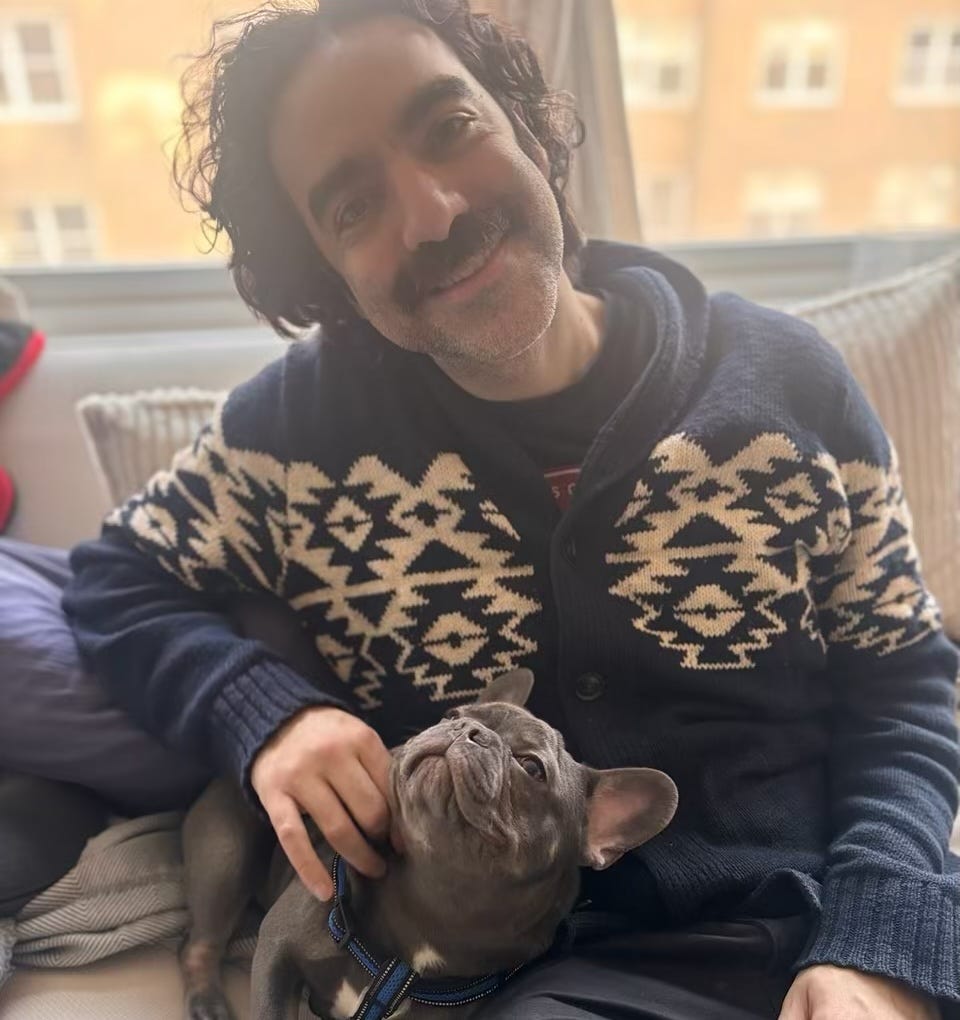
Marc: One thing that’s so moved me is that he [the puppy] is hardwired to want to play. It’s such a beautiful thing — this need to play. And I think art has a personal function of playing, and a social function of connecting. The question is: because art now makes money, somebody might want to use AI purely as a way of making money. And if that’s the case, it’ll probably be a successful tool. But there are easier ways to make money.
It really depends on why you’re trying to make art.
Me: That’s so interesting…I sometimes use AI as a stand-in collaborator when I don’t have a human one available. And as someone who really likes working with collaborators, I appreciate that use case. But it doesn’t have the same element of play that I think the best creative collaborations have.
Marc: Right. And I actually have difficulty asking people to collaborate with me. I have these self-limiting beliefs — like, if I’m asking them to help with my idea, it’s a zero-sum thing. So I either abandon my ideas and let someone else steer the ship, or I try to do everything myself. With AI, it is tempting to make it less lonely.
Marc: I’m having this dual thing where on my right side I have the computer, and on my left side I have the puppy. The puppy is supposedly less intelligent, but in a lot of ways he has advantages.
Lol! Yes, I pick the puppy.
Will AI ever write Hey Jude?
Marc: Will it create a song that is truly as good as Hey Jude? Where you hear it and you’re like, I know this is not a real person, but this moves me so much? I kind of think it will, just by sheer numbers. Like a monkeys-at-a-typewriter thing, except these are really educated monkeys.
But that doesn’t mean there’s not also room for whatever else.
Me: I wonder if people will like it as much, though. Like…I like Beyoncé songs because they’re good songs, but also because of what Beyoncé stands for.
Marc: Right, it’s connection with the person. But then — we’ve seen so many of our artistic heroes get exposed as not-great people. And there’s that argument of, can you separate the artist from the art? Not even ethically — literally. Can you still enjoy it, or are you thinking the whole time, this person’s a scumbag?
Me: Yeah — I don’t actively put on Michael Jackson songs anymore. But if I’m at a place and they’re playing Michael Jackson, I’m like, okay, I admit it! This is a great song!
Marc: And I think that’s a similar analogy to, like — will I feel moved by something a robot made? Maybe? I don’t know.
Where he landed
Near the end of our conversation, Marc said something that’s stuck with me:
Marc: It seems like we’re all kind of rationalizing our own desires to use AI. We’re all basically making excuses — I would draw the line here, but I would never do that. On the one hand, there’s a very human, self-serving bias. And on the other, there’s a totally legitimate wrestling with our own values — what we value about making art and being creative.
Because there are people who just want to get famous or get paid. And I can see that they would use AI very differently from how I would, because I genuinely want to make something that, for some reason, when I was a kid, I decided was important to me.
Maybe art is my need to chew on things. Like my dog chewing to keep his jaw strong. But on a deeper level, it makes me feel centered and stable and excited. And once AI showed me that the Olympic-gold-medal thing might happen at the click of a button — it’s not as interesting anymore. So it’s really become about the process.
The AI rabbit hole that changed his brain
Me: Ok, we’ve talked about how you don’t use AI, but what are your favorite uses of AI?
Marc: Learning. I used to sit in bookstores in the art section and read for three hours to get four insights. Now I get ten insights in a split second.
I have ADHD, so reading long-form criticism has always been hard. I’ve always known that was a gap in my ability to progress. I’ve probably read thirty to fifty screenwriting books over the years. But with ChatGPT, I’m basically getting an amalgamation of all the best music criticism written since David Bowie came on the scene sixty years ago.
Me: What’s an example?
Marc: Like, “we can be heroes just for one day” — it could mean, we can be heroes, and that would be enough, even for just one day. Or the darker way: we can be heroes, but tomorrow we won’t be. That’s just one little insight that I can take to my own writing. How can I tweak one line to be a little more noncommittal, leave the question open? That’s something you might learn in a poetry class. But I just got it in seconds.
So far so good. AI as a brilliant, infinitely patient teacher. But shortly after our conversation, Marc texted me something else on this topic:
Marc (via text): I went really deep into an [AI] rabbit hole, which was very exciting, and then about a week later I find myself in a state of mind that is completely unable to handle the delayed gratification required to sit down and create something that isn’t instantaneously occurring. There’s a visceral feeling of perfectionism — I want perfect results, complete results, right this instant.
Remember, this is not even the result of using AI for generating art. Simply for asking questions. But the expectations it has subconsciously implanted in my brain are very, very strong.
The feeling is: give me the answer. The entire answer. Perfectly. Right now. And then a screaming baby inside my head.
It saved me time, but I’m paying a different type of cost. I’m going to try to brute-force slow down my mind with meditation and slow exercise. I’m at 60p now. I want to get back to 24p.
(For the non-filmmakers: 60p is a high frame rate that looks hyper-real and slightly uncanny — think a soap opera. 24p is the classic cinematic frame rate. It’s a great metaphor for what AI did to his brain.)
These texts made me think. Even though I reached out to Marc partly because he’d been doing a lot of creative work about AI, and clearly thinking about AI a lot, he was using AI in his creative process less than I’d expected. Way less than I do, and way less than a lot of people in my circles — people who, even if they want to stay central to the creative process, are comfortable using AI for light editing, brainstorming, etc. He seemed very certain, and very disciplined, about the idea that using AI would harm his process, even as he was also convinced of how good it was and how helpful it could be for other uses, like learning.
It made me more aware of how often and how reflexively I’ve been using AI — in my personal life, my professional life, my creative life. I’m intellectually comfortable with my uses. I always begin with my own ideas, and end with my own edits and voice. And I can see ways my AI use has helped me professionally and creatively. I’ve even taught workshops and talked on panels about those benefits. But after talking to Marc, I started to wonder more seriously about the costs. It’s not a new idea, and I often think it’s overplayed — but I felt myself starting to shift.
Then, right around the time Marc sent those texts, I read David Brooks’s “The People Who Will Thrive in the AI Age” in The Atlantic, which put some research behind the feeling. Brooks cites a study finding “a significant negative correlation between frequent AI tool usage and critical thinking abilities.” But one passage in particular felt like it really spoke to Marc’s points.
Brooks describes what he calls “mental marathoners”: people with a high need for cognition who actively wrestle with AI instead of letting it do their thinking for them.
I suspect the mental marathoners are going to work really hard to resist AI entropy. They are going to feel a strong desire to be original. In this age, cultural output will feel ever more familiar, as writing, songs, and movies become syntheses of what has already been produced. Marathoners are going to want to produce work, by contrast, that feels personal, that reflects their unique self.
And, Brooks basically says, the marathoners are going to win. I sent it to Marc. He seemed to feel seen!
Where this leaves things
Almost none of Marc’s hesitations were actually about what AI can do. They were about what gets lost if the friction disappears — the slow read in the bookstore, the ego hit of someone pressing a button and getting his result, the screaming baby in his head demanding instant perfection.
His bottom line might be the most useful framework I’ve heard yet for thinking about any of this:
It really depends on why you’re trying to make art.
If the point is the output, AI changes the math. If the point is the playing and the chewing — the puppy-needs-to-chew, identity-stabilizing, slightly obsessive process of it — it changes a lot less.
Marc Philippe Eskenazi is a writer and musician based in New York City. You can find his work in The New Yorker and follow him on Instagram! I promise he’ll make you giggle (and you might just catch some more puppy pics too).